AstroGuide:Portfolio Chris Hollander’s Astrophotography
← All research

Regional survey · stellar nurseries and stellar remains

Orion and the winter Milky Way survey

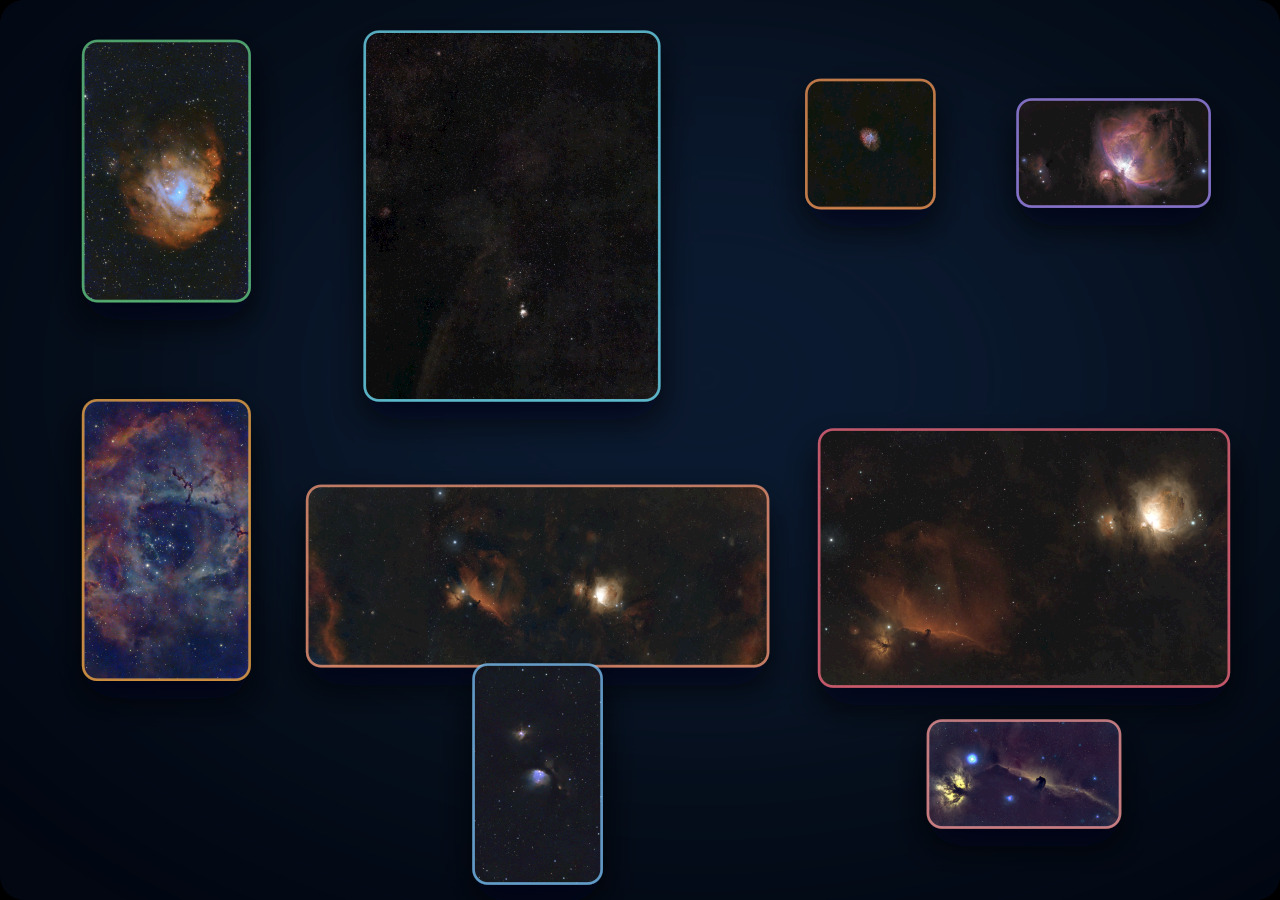
Move across a wide winter Milky Way field into Orion's bright stellar nurseries, nearby reflection nebulae, the Rosette and Monkey Head regions, and the Crab Nebula.

9linked images
1root fields
4nested levels
A compact nested sky map moving from a wide Orion and winter Milky Way field into individual nebulae and a supernova remnant.
Milky Way · Orion and the winter sky · compact scale map Configured from Orion Survey.md

Registered scale map

Travel from sky region to target

8 of 8 transitions registered with WCS · branches mapped around the root
Overlays
  1. MilkyWay Orion

    Milky Way · Orion and the winter sky

    A 36-minute S30 Pro wide-camera view spanning Orion, Monoceros, Taurus, and a broad sweep of the winter Milky Way.
  2. Gemini/Auriga Region

    M1 · Crab Nebula

    The expanding remnant of the supernova recorded in 1054, projected into the Taurus end of this wide field.
  3. Gemini/Auriga Region

    NGC 2174 · Monkey Head Nebula

    An H II region and active stellar nursery near the Orion–Gemini border.
  4. Gemini/Auriga Region

    NGC 2237 · Rosette Nebula

    A broad ionized cloud wrapped around the young open cluster at the center of the Rosette complex.
  5. Barnards Loop

    Barnard's Loop · 8h

    An eight-hour field spanning Orion's Belt and Sword and the arc of Barnard's Loop.
  6. Orion Complex

    Orion's Belt to Sword · 3h 20m

    A 3-hour 20-minute D5300 and Seestar S30 Pro composite joining the Horsehead and Flame region to M42 and M43 in Orion's Sword.
  7. Orion Complex

    IC 434 · Horsehead Nebula

    A dark cloud silhouetted against glowing hydrogen beside the bright star Alnitak.
  8. Orion Complex

    M42 + M43 · Orion Nebula

    Orion's immense nearby stellar nursery, shaped and illuminated by massive young stars around the Trapezium.
  9. Orion Complex

    M78 · Casper the Friendly Ghost

    A blue reflection nebula where young stars illuminate surrounding interstellar dust.

Orion and the winter Milky Way survey

A wide winter field

Orion is one of the most recognizable constellations in the sky, but the familiar outline is only the foreground of a much richer region. A wide exposure reveals glowing hydrogen, dark molecular clouds, reflection nebulae, young clusters, and the dense star fields of the winter Milky Way. The registered scale map connects that broad context to the latest detailed capture of each subject contained within it.

The branches cover several different stages in the lives of stars. M42, M43, the Horsehead, M78, the Monkey Head, and the Rosette all trace clouds where stars are forming or reshaping their surroundings. M1 is fundamentally different: it is the expanding debris left after a massive star ended its life as a supernova. Their proximity in this map describes their apparent positions on the sky, not membership in one physical complex.

Reading the branches

  • M42 and M43: The brightest part of the Orion Molecular Cloud complex, where ultraviolet radiation from the Trapezium cluster lights and sculpts the surrounding gas.
  • Horsehead and IC 434: A compact dark nebula seen in silhouette against a curtain of ionized hydrogen near Alnitak.
  • M78: A reflection nebula whose blue light comes from dust scattering the light of embedded young stars.
  • Rosette and Monkey Head: Two large H II regions in the broader winter Milky Way, each shaped by recently formed massive stars.
  • Crab Nebula: A young supernova remnant in Taurus, providing a view of stellar death alongside the field’s many stellar nurseries.

The map uses aligned rows to keep the wide fields and their closer views easy to follow. Connecting lines and registered footprints show the parent–child framing relationships on the sky.