
Story
Bubble Nebula in multiple palettes
The Bubble Nebula captures one of the earliest chapters in the life of a massive star.
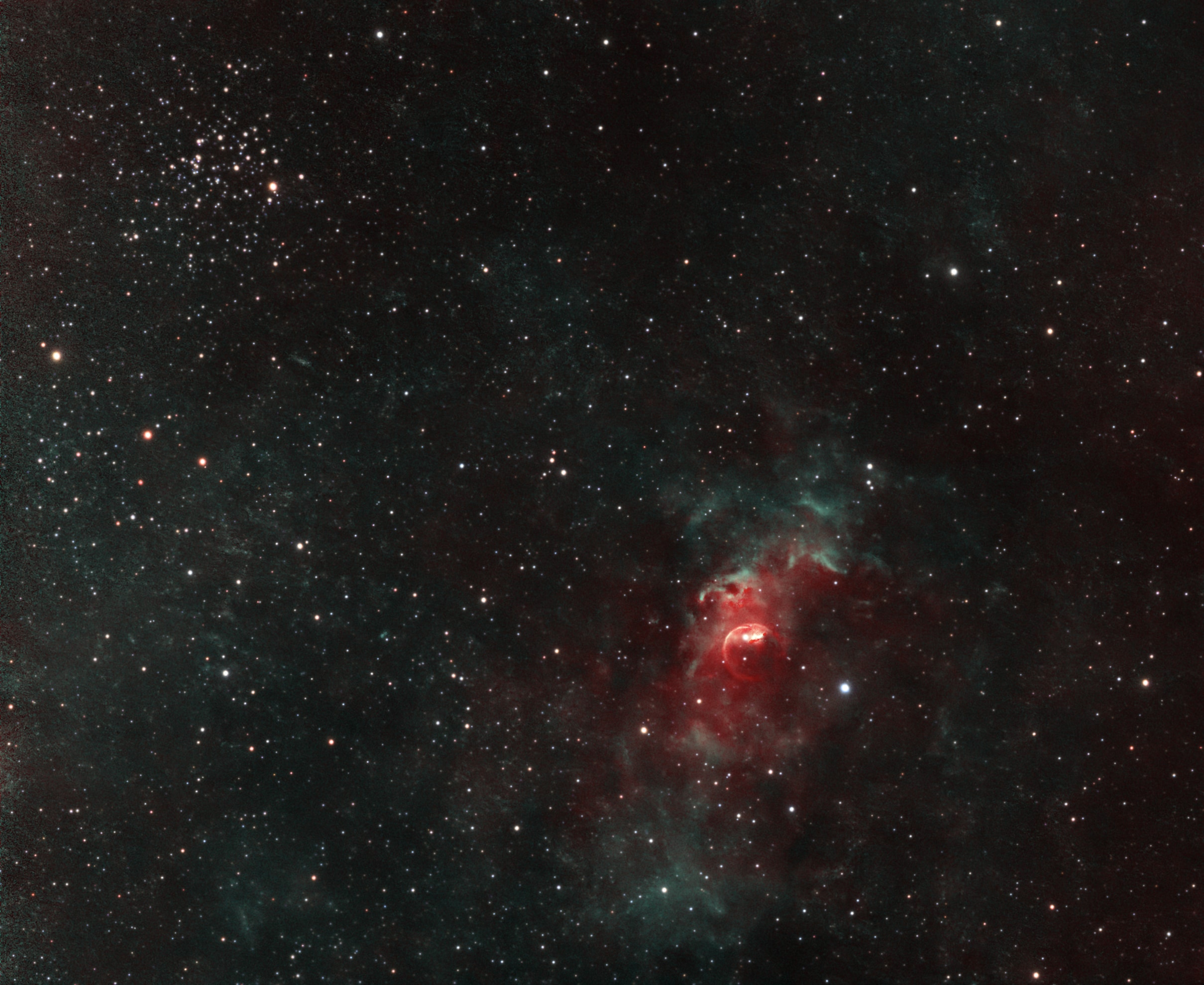
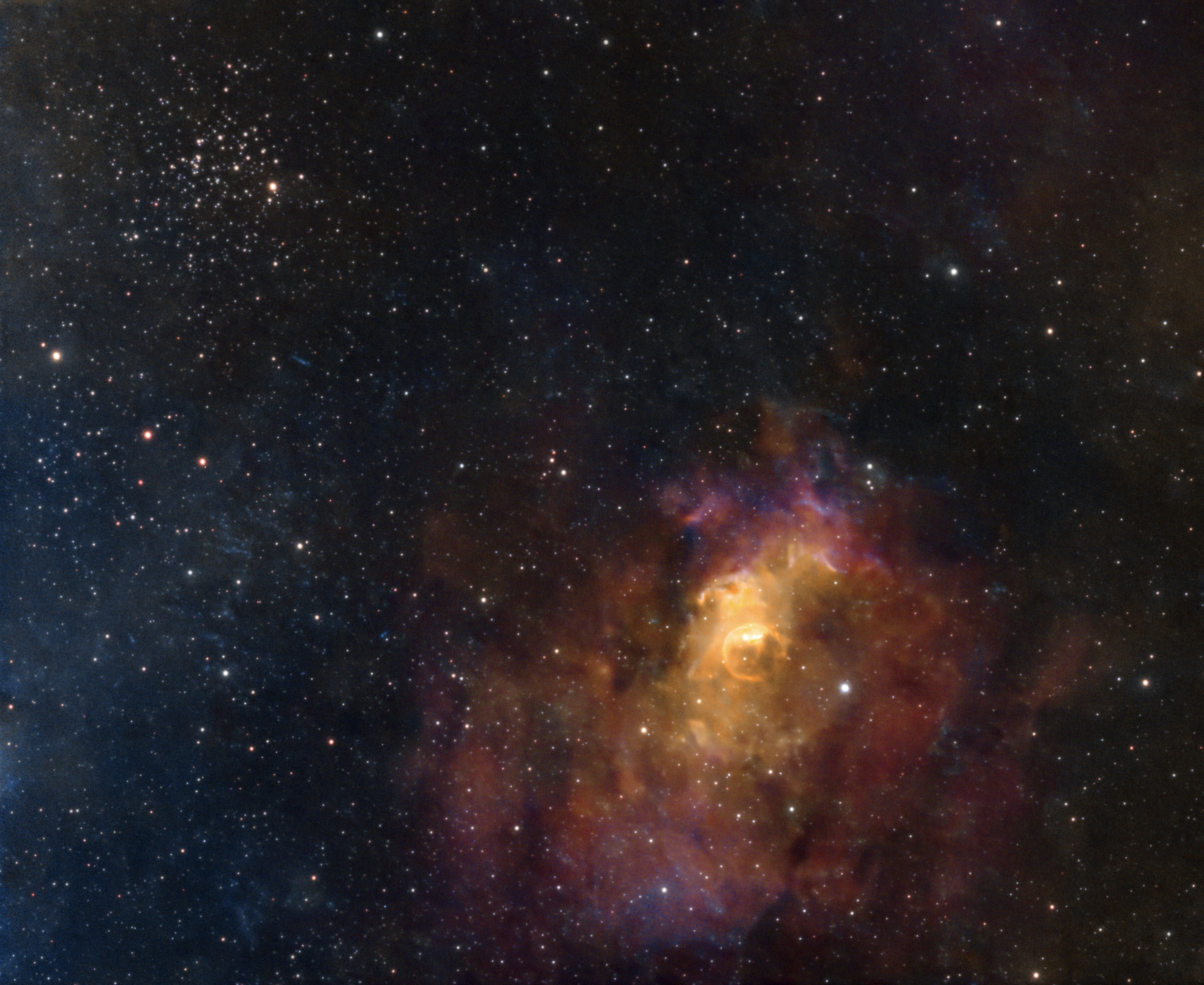
Bubble Nebula in multiple palettes
These aren’t three artistic interpretations of the same image. They’re three different ways of visualizing the chemistry of the nebula.
| palette | red | green | blue | interpretation |
|---|---|---|---|---|
| HOS | hydrogen-α | Oxygen | Sulfur | vibrant golden glow created by the dominant elements (Hα and OIII) |
| OSS | Oxygen | Sulfur | Sulfur | now with OIII in the red channel and SII in both blue and green, we can see how little sulfur emission is available |
| SHO | Sulfur | Hydrogen-α | Oxygen | we see the familiar teal because of Hα and OIII in blue and green channels, but we miss the golden hue because of diminished SII emissions. |
Notice what doesn’t change: No matter how the channels are mapped, this region is overwhelmingly dominated by hydrogen and oxygen. Sulfur is present, but only in relatively small amounts. In the HOS image it’s barely visible as hints of blue, and in the OSS image it contributes very little to the red oxygen signal. Even the classic SHO “Hubble palette,” which often produces rich golds and teals, is overwhelmingly blue here because there simply isn’t much sulfur to display.
To me, that’s the fascinating part. The colors aren’t telling us what the nebula looks like—they’re helping us understand what it’s made of.
The Bubble Nebula is another stellar nursery, but unlike the Heart, Soul, or North America Nebulae, the most obvious feature isn’t the cloud itself—it’s how a single massive star has begun reshaping that cloud.
The central star is a very hot, relatively young O-type star. While our Sun is 4.6 billion years old, this star is only about 2–4 million years old. The bubble itself is even younger; only a few hundred thousand years old. During that time, the star’s stellar winds having been carving the bubble out of it’s surrounding cloud.
Over the next few million years, the star will exhaust its fuel, leave the main sequence, and likely end its life as a supernova. When that happens, the Bubble Nebula will be reshaped once again. The resulting shock waves will create conditions that produce much stronger SII emission, making this region look dramatically different than it does today.
Comparison
Bubble Nebula
Drag between HOO and SHO processing variants.